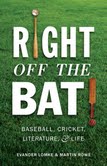
Right Off the Bat Podcast: 02

RIGHT OFF THE BAT PODCAST: 02

 * * * Listen here * * *

Martin: Hello again. My name is Martin Rowe, and this week we’re celebrating the 70th anniversary of a special event in baseball and doing a bit of random name-calling.

However, before we reach the heights and descend to the depths, I want to give new listeners an idea of the kinds of things we’ll be talking about in these podcasts and that we reflect on in our book, Right Off the Bat. Our main aim as writers (and podcasters) is to avoid some of the more arcane aspects of both sports, such as specialized terminology and rules, and concentrate on the sheer beauty and lifelike ingeniousness of cricket and baseball. We have a bit of fun with the silly things and we’re not afraid to talk about some of the ugly stuff that goes on as well. But the main point is to celebrate the glorious moments and records of each sport without dwelling on the past for its own sake or wallowing in nostalgia. As we all know, the past is highly overrated—usually. Sometimes, however, memory does not play tricks on us, and this brings me to the subject of today’s podcast. So, Evander, what happened 70 years ago this week that we should celebrate?

Evander: Joe DiMaggio’s 56-game hitting streak. When Joe DiMaggio was up and coming, Babe Ruth was in decline. DiMaggio would come to represent what Tom Brokaw calls “the Greatest Generation.” Whether the following story is true or not, elements of it have the ring of authenticity. Ruth famously couldn’t remember the names of his young teammates. Everyone was, “Hey, Kid!” But there was one youngster he knew by name from the get-go, and this was Joe DiMaggio, the soon-to-be-nicknamed “Yankee Clipper.” I believe it is poet Donald Hall in the Burns Brothers’ tremendous 18-and-a-half-hour history of Major League Baseball who describes DiMaggio as “the ultimate in celestial craftsmanship.” Sports commentator Bob Costas has described his own father as a Joe D. fan. When Costas sung the praises of his boyhood hero, Mickey Mantle, Costas Senior quickly added: “Unless you’ve seen DiMaggio, you haven’t seen the Real Thing.”

Martin: I think even cricket fans have heard of Joe DiMaggio. He was obviously pretty special from the beginning.

Evander: Correct! He was actually on his way to becoming a world-class tennis player. But his talent for baseball was so unusual and overpowering that the tennis career was aborted. Other teams shied away from DiMaggio because he had a leg injury or series of them. The Yankees, on the other hand, knew thoroughbred talent when they saw it. So did Ruth, who spotted the heir apparent immediately.

Martin: So, let’s get back to the hitting streak. I think cricket fans would recognize that it’s hard to hit a baseball with a round bat. But they may be missing the significance of what you mean by a “hit.” You’re not talking about getting the wood to meet the leather. You’re talking about hitting the ball into space and getting to first base (at least) in 56 consecutive games, right?

Evander: Yes. It’s one thing to hit the ball at all. It’s another thing to hit the ball and far enough away from a fielder that they can’t throw it to whatever base you’re running to before you reach that base. DiMaggio was a unique figure in baseball history. He holds few lifetime records. He couldn’t be more different from the gold-standard, Ruth. Indeed, they seem to inhabit two different universes as, to use a literary example, with the difference of only a generation or so, Shakespeare and Milton do. The lives overlap, but they have nothing to do with each other, embodying “adjoining eras” marked by radical change. Moving on and more to the point, it had been Ruth himself who held the Yankees’ record for batting successfully in a sequence of games: 29. Let’s put this into perspective. To reach base safely for 29-straight games on the Major League level, one must have an almost unprecedented combination of steely will and transcendent talent. In 1941, Joe D. would almost double the length of this streak.

Martin: Beating a record by double is just astonishing. But what really impresses me is DiMaggio’s nerve. Each game that passed, and each time he came up to bat—perhaps four or five times in the course of a game—he must have had to block out of his head any thought of “I’m on this incredible streak. I have to hit the ball.” He had to take each ball on its own merit—in a microsecond of time—and make that decision. And he still hit into space, as they say.

Evander: Right. The difference between 29 and 56 is staggering. In fact, the difference between 44 games, the next-highest total, held by two players, is akin to point-rises on the Richter Scale, as the batter continues to bat successfully day after day. (Remember, baseball is in large degree a game of controlled failure, so that a batter hitting an incredible .400—Ted Williams was the last to accomplish this, also in the annus mirabilis 1941—is failing to bat successfully 60 percent of the time). Just a week ago, Andre Ethier had hit safely in 30 straight. Last season, Buster Posey had a streak of 21. The thing is, the pressure builds exponentially once the player reaches about 30. Like so much in baseball and life, mysterious forces of failure or entropy start pushing back.

Martin: It’s interesting the streak happened in 1941. Virtually the rest of the world is at war, and by the end of it America will be so, too, and then there’s this golden summer, with this streak. There’s something ethereal and timeless about it—as though the sound of the crowd and the thwack of ball and bat drowns out all of the horrors happening elsewhere. As a Brit, I can say it’s simultaneously one of the most attractive and annoying aspects of the United States. You can sense the confidence, the insularity, the blocking out of all that’s negative or insoluble, the love of the heroic individual, the grandness of the gesture and at the same time its innocence and relative inconsequence as the tired old empires, countries, and dominions fight it out. And then there’s DiMaggio: a guy from the other side of the Anglo-Saxon tracks, as it were, who makes it in the Big Time: that’s America to me, to quote another great Italian-American from the same era, Ol’ Blue Eyes. There’s something gutsy and straightforward about the streak—to keep on hitting that ball, over and over again. Simply irresistible, to cite the late, great philosopher of life, Robert Palmer. So, do you think anyone’s going to beat it?

Evander: I am far from the only one to believe it is unlikely to be broken— even though all records are meant to be. It is a standard that has little to do with the power sought through anabolic-steroid ingestion or the weight room. Players that have hit 60 or 70 home runs in a season, Ruth being an exception as he almost always is, may never have batted successfully in a dozen straight games. Baseball mingles luck with skill in, again, a mysterious and lifelike way. What makes baseball different from every other sport, including cricket, is that it is played daily. There is an episodic aspect to fandom. “What will my favorite player or team do today?” Fact is, no one could have anticipated the sheer drama of a hitting streak like DiMaggio’s. It stunned and galvanized a nation in a way that is a little hard for us to comprehend 70 years later. Should any player approach 40 or 45 games in a row, the excitement and anticipation over the preceding two weeks onward would be almost unparalleled. When will this player fall off the DiMaggio ledge?

Martin: Well, it almost seems like cricket is being played every day somewhere around the world, but your point is well taken. Thanks for that: Seventy years ago this week. The music you’ve been listening to is by Bettie Bonny and Les Brown and His Band of Renown performing “Joltin’ Joe Dimaggio,” on rotation here at Right Off the Bat.

Now another topic. I’m sure you were paying close attention during the recent Royal wedding.

Evander: I was glued.

Martin: And no doubt you’ll have heard Kate Middleton recite all four of Prince William’s first names: William Arthur Philip Louis. That’s quite a mouthful. Of course, long names are a tradition in the aristocracy. William’s grandfather, Prince Philip, is according to his birth certificate, Prince Philip of Greece and Denmark and a member of the house of Schleswig Holstein-Sonderburg-Glücksburg, which is some address to throw on an envelope.

Evander: I believe the house is in Queens.

Martin: You may be right. Anyway, if you feel sorry for the fellow who had to write that name out in nice cursive script on the scroll or parchment or whatever they used when bonnie Prince Philip burst into the world, then you’ll really pity the clerks in the Sri Lankan birth registry offices. The Sri Lankan cricket side is playing some warm-up matches in England at the moment, before beginning a Test and one-day series against the home team, and in the squad are the magnificently entitled Hettige Don Rumesh Lahiru Thirimanne (that’s four first names, if you’re counting) and Herath Mudiyanselage Rangana Keerthi Bandara Herath (which is five first names, except one name is also his last name, so that makes it easier). But the winner has to be the triumphantly nomenclatured Uda Walawwe Mahim Bandaralage Chanaka Asanga Welegedara. With that name tag on your shorts, I cannot imagine that you don’t feel somewhat fortified when you come out to bat.

Evander: So what kind of firepower do the English have in response?

Martin: Well, if they stick with the team that beat Australia earlier this year, then the best that they can come up with is Ian Jonathan Leonard Trott.

Evander: It’s not looking good. The English are syllabically challenged.

Martin: That they are. Thankfully, what they lack in nominal strength they make up for by playing in front of a lot of syllabically challenged fans called Ian and Trevor and Roy. However, according to the actual rankings—the ones that deal with games won or lost—the Sri Lankans are a better side than England at the moment. If England beat the Sri Lankans and then the Indians (who have many great players with even more magnificent names than the Sri Lankans), then they stand a good chance of becoming number one. But it’s a long shot.

Evander: Let battle be pronounced!

Martin: Yes, indeed. So, that’s all we have time for this week. As always, we’ll keep you posted on anything important that happens—and a great deal of unimportant stuff that occurs as well. Check out our website—rightoffthebatbook.com—for more blogs and stuff. Our book has now arrived in our moistened fingers here at Right Off the Bat headquarters and it’ll be available from Amazon and in bookstores by the end of the month. You’ll also be able to get your electronic devices to display the e-book version of Right Off the Bat soon enough. And so, this is Martin Rowe and Evander Lomke . . .

Evander: Or is that Evander Lomke and Martin Rowe . . . ?

Martin: Signing off. And wherever you are and whichever game you play, may the ball always meet the middle of your bat, or arrive in the gloves with a satisfying thud.

Posted in Baseball, Cricket, England, Right Off the Bat Podcasts, Right Off the Bat Website, Sri Lanka, Yankees | Tagged , , , , , , , , , , , , , , , | 1 Comment

Right Off the Bat Podcast: 01

RIGHT OFF THE BAT PODCAST: 01

* * * Listen here * * *

Martin: Welcome to the very first Right Off the Bat podcast—your must-listen station for news and views about the weird and wonderful worlds of cricket and baseball—or should that be baseball and cricket? Either way, my name is Martin Rowe, and I’m here with my colleague Evander Lomke. Or is that Evander Lomke here with me Martin Rowe?

Evander: Hello, listeners.

Martin: It’s Friday the 13th of May, and as far as we’re concerned we could walk under a ladder with a broken mirror and a litter of black cats and it couldn’t be a more auspicious day, since we’re expecting at any moment the arrival of our book Right Off the Bat: Baseball, Cricket, Literature, and Life, in which Evander and I expatiate on the ups and downs, the highs and lows, the past and present, and the myths and truths surrounding the two games that we love so much: cricket and baseball. But since this is the first podcast we’ve done—on this or any other occasion—we’re going to take up your time in this one by telling you a little bit more about who we are. If you want to see what we look like, read more about the book, or check out our blogs, visit our website: rightoffthebatbook.com. OK, so first of all, Evander: Why don’t you tell us a little about yourself?

Evander: OK. I was born in the New York suburb of Mount Vernon, but I’ve lived almost all my life in the Bronx. My mother, Rosalia, “Leah” as she was known in America, was invited to the U.S. with her family from Palermo. Grandpa Giovanni, who was a sculptor, founded the art department at Antioch College in Yellow Springs, Ohio. When Giovanni became too sick to work in Ohio, he took his family to Brooklyn. Leah became a lifelong fan of the Yankees, to the point of keeping daily score cards from Mel Allen’s radio broadcasts.

My father, Lester, was the firstborn American on the Lomke side of my family. His father, Simon, known in America as Samuel, was likely from Lithuania or Belarus. A maker of bed frames, he married Aneta, known to me as Anna, in her home city of Odessa. Though he loved to play baseball and its urban variants, young Lester had poor eyesight.  Lester was a big Yankees fan, a Babe Ruth man, and even more, a Hank Greenberg follower.

Mom and dad permitted me to learn baseball at my own pace. I remember going to a game, with a plastic bat, a rubber ball, and a small glove, at the age of six or younger—though I believe I was taken to Ebbets Field at three. Most of my family, on both sides, were Yankees fans, but other members pulled for the Dodgers or Giants.

I was never terribly athletic, though I was once timed running 40 yards at 4.9 seconds. I had passable reflexes, and a decent throwing arm. But I couldn’t reliably catch fly balls no matter how much I practiced. In the field—whether engaged with baseball, softball, punchball, or stickball—I was more apt to make a spectacular play, blowing ten easy ones for each circus catch.

What I was really good at, however, was watching baseball games and reading baseball biographies. At nine, ten, and eleven, I devoured the boy bios. I went to a lot of Yankees and Mets games during the Wonder Years. I had better-than-average baseball-card collections. I collected Street & Smith’s and Who’s Who in Baseball (I practically memorized them). And even as I grew into adulthood, marriage, and fatherhood, I continued to devote way too much time to watching—even better, listening—to games on the radio. I never kept score as Mom did. But I’m sure I have listened to more games than she did.

In Right Off the Bat, Martin and I attempt to demystify the respective lores of baseball and cricket. We want you to see a game, baseball or cricket, even to try your hand at it. In this crazy world, these games can somehow distill some of the best aspects of humanity: unscripted drama with a tinge of artistic and religious zeal. Like life itself, these games can be a bore at many times on many levels. But when the action reaches a fever pitch, there’s nothing quite like them.

So that’s my story. Now it’s Martin’s turn to tell you a little bit about himself.

Martin: I was born and raised in England and learned cricket from my father and the two schools I went to from the age of eight to eighteen. I was always more enthusiastic than talented, and I think I was allowed to be a member of the various teams I played for because I was the only one who understood the rules. In 1978, my father realized a lifelong ambition and got a job at the Marylebone Cricket Club (or MCC), the storied home of cricket at Lord’s cricket ground in North London. The perks included free tickets to games and indoor coaching, which I received gratefully for two years beginning when I was thirteen. It didn’t make me any good at the game, but it ignited my enthusiasm, and while the strength of my hand–eye coordination has waned, that never has. Even though I haven’t played seriously in over twenty years, I follow games online and in due course joined my father as a member of the MCC.

Evander took me to my first baseball game in 1996, but I’d cast an interested eye over the sport since my arrival in the U.S. in 1991. At first, it was hard to get used to the noise and extraneous entertainment of the American game, but as anyone who’s been to or seen a one-day cricket match anywhere in the world will know, cricket is no longer a game of polite coughs, gentle applause, and the occasional strangled shout of “good shot.” Perhaps it never was that really. Anyway, that first game stimulated between us a conversation about baseball and cricket that’s been going on ever since. Last year, we decided to turn that discussion into what we fancifully call “prose,” and it’s called Right Off the Bat, and it’s arriving today.

Right Off the Bat is a reflection on, and celebration of, the numerous parallels and several tangents that have marked the mutual histories of baseball and cricket. We didn’t want to overwhelm the reader with the technical stuff that can easily put the casual observer off either game, and we wanted to avoid the tendency that both neophytes and old-timers have to wander off the clear path of understanding and illumination for the thick reeds of jargon and the thornbushes and briars of arcane lore.  It’s our contention that, at heart, both games are pretty simple: a guy with a piece of wood in his hand is trying to hit a spherical object, and usually missing, and one team is attempting to score more runs than the other. And that, Evander, is that.

Evander: OK. There’s a lot of baseball happening at the moment, since the season in the U.S. is well underway, and the competition is heating up. I’ll have more to say about it in the next podcast. But you can read my tips for the playoffs right now at rightoffthebatbook.com.

Martin: And, after months and months of one-day cricket of one sort or another, we’re now beginning a stretch of the year where the longest form of the international game—Test cricket—is being played. So, we’ll fill you in on that in due course. You can sign up to receive news about our podcasts by going to the website: rightoffthebatbook.com. You can get our book on Amazon and, by the end of this month, you’ll be able to download the e-book—chock full of extraordinary facts and shocking revelations (and that’s only the copyright page). Until next time, then. This is Evander Lomke and Martin Rowe . . .

Evander: Or should that be Martin Rowe and Evander Lomke?

Martin: . . . signing off, and wherever you are and whichever game you play, may the ball always meet the middle of your bat or arrive in the gloves with a satisfying thud.

Posted in Right Off the Bat Podcasts | Leave a comment

Farewell, Harmon Killebrew

Harmon Killebrew: The bat looks like a toothpick in his hands.

Harmon Killebrew died today. He died much too soon. He was the premier slugger of my tweens. He came close to hitting 50 home runs in a season several times. When Killebrew launched the ball, he launched it: so-called tape-measure shots. He never played on a World Series winner. I remember some magazine article quoting a player or executive dismissing Killebrew for “throwing like a girl.” How ridiculous . . . . Killebrew was a gentleman’s gentleman, with a career somewhat reminiscent of Ralph Kiner’s. (Kiner, of course, was more the glamour-puss legend: he dated Elizabeth Taylor when the Movie Queen was quite young.) The lifetime home-run percentage of Killebrew, who had a longer career, and Kiner, are quite close, and for many years not distant from Babe Ruth’s (no longer first). Farewell, Harmon Killebrew, pride of the Minnesota Twins.

Posted in Baseball | Tagged , , , | Leave a comment

Jorge Posada Non-Incident Story Gains Non-Momentum

Yankees officer Randy Levine steps from the shadows to the marketplace.

When captain (cricket followers: the designation of “captain” on a baseball team is not part of the structure of the sport, it is a symbolic overture) Derek Jeter publicly stated he could understand where long-time teammate and “brother” Jorge Posada was coming from in removing himself from the lineup his manager had made out, perhaps without an injury of the magnitude that normally would have kept him from playing, the Yankee front office did what it usually does. It flipped. As reported on the New York Yankees website, the executive folk all bent out of shape with Jeter’s freedom-of-speech-guaranteed-by-the-U.S. Constitution observation included Brian Cashman, Randy Levine, and Hal Steinbrenner. “We’re all on the same page now.” Sure . . . . Posada is sitting out another game. “As we would have sat Georgie out today anyway: in Tampa, where the Yankees train in winter and have their corporate offices, against the team that plays there all the time and is in first place several games ahead of us.” Uh-hunnh.

Posted in Baseball, Yankees | Tagged , , , | Leave a comment

Sale-ing up the Amazon

A few days ago, Right Off the Bat was sitting marooned on a sandbank in the Amazon delta at 4,998,000-odd in terms of its rankings. We check in today, and lo and behold, a stiff breeze has filled its sales and it’s moved up the mighty bookstream to number 254,247 at this writing—and that’s without the book finding safe harbor on the shelves or anchoring itself in some electronic device. Like all authors, we’re the last to know or understand what’s happening. But we’re very grateful that our stately galleon is underway.

Posted in Right Off the Bat Book | Leave a comment

The Jorge Posada Non-Incident

Jorge Posada: Everything's copacetic. Kapeesh?

“The person said the Yankees had been in contact with the commissioner’s office about a possible penalty. The Yankees could have fined Posada one day’s pay—that would be $71,978 on his $13.1 million salary.” Say, that’s a nice piece of change. I wonder who this *person* is. Yankees manager Joe Girardi ya think? Executive Randy Levine? Yankees part-owner Hank Steinbrenner? First-ever DH Ron Blomberg (he who paved the way for Jorge Posada, Don Baylor, David Ortiz, and others)? The bat boy maybe?

Posted in Baseball, Yankees | Tagged , , , , , , | Leave a comment

The Jorge Posada Incident

Jorge Posada: Why is this man laughing?

There is a picaresque aspect to baseball. It is played every day and the drama and plot lines of a season build from the long schedule. Tonight the Yankees, a team mired in a slump, were to play an unusually scheduled, nationally televised Saturday-night game. A half-hour before the start, the Yankees one-time catcher, now aging and slumping (even more than his teammates) designated hitter Jorge Posada, pulled himself from the lineup upon being dropped to the bottom, usually reserved for the worst-hitting player on the team. Manager Joe Girardi later found himself tossed from the game for arguing with the umpire, maybe two hours after his behind-closed-doors confrontation with Posada.

It was a tough night for the Yankees, even for mid-May, still the infancy of any season. Stories vary on what was said, to whom, between Posada and Girardi. Bear in mind it was Posada who took Girardi’s job as the full-time catcher in the late 1990s. Bear in mind this was a nationally televised, relatively high-profile game against an arch-rival. Players can be dropped down in a lineup during any of the 162 games in a long season, or even the postseason: Why this one in particular? On the other side, insubordination by a player, once upon a time, meant the end of his career with a franchise via trade, or, somewhat less dramatically, suspension without pay.

It is impossible to know every detail that led to this shadow box: a one-time team leader, aging and marginalized; a manager who must work thro the big picture and defuse the emotional impact on all his players; a front office that cannot be happy with either protagonist.

Ironically, as Posada and Girardi conducted their pregame summit, I was having a most pleasant meeting with “the Jewish Mickey Mantle,” long retired, Ron Blomberg. On April 7, 1973, Blomberg of the Yankees became the first designated hitter in the history of baseball, anywhere in the world, facing Cuban-American pitching great Luis Tiant. The bat used is in Cooperstown. The immortal Mr. Blomberg let me have one of his french fries!

For me, this certainly has been the evening of designated hitters.

The other picaros resume their passion play tomorrow. (Mixed metaphor: it’s OK.)

Posted in Baseball, Yankees | Tagged , , , , , | 1 Comment

And Now It’s Here

Yes, the book’s arrived, and we couldn’t be happier than a brace of clowns who’d just won the lottery and had ingested an Ecstasy pill on nitrous oxide and were attending a comedy club. To celebrate, we’ve launched our very first podcast, in which we talk about our background and interest in cricket and baseball. Listen to here: Right Off the Bat: Podcast 1.

Posted in Right Off the Bat Book | Leave a comment

It’s Almost Here

The first copies of Right Off the Bat have rolled off the presses and are winging their way to our office at this very moment. To celebrate their imminent arrival, we’ve set up a new section—News and Events—which will cover all the reviews, stories, and signing events that we’ll be doing in the course of the book’s (hopefully long and happy) life. We’ve already got an event at BookExpo in May, so visit the page now!

Posted in Right Off the Bat Book, Right Off the Bat Website | Leave a comment

Hurray for Captain Spalding

Thank you Dr. Van Ornum, former president of the Cal Koonce Fan Club, for alerting our readers and me to these guides!

“The Library of Congress has more than one thousand of these guides, believed to be the largest collection held by any institution. A small sample is offered in Spalding Base Ball Guides, 1889-1939; in the future, the entire collection may be digitized and made available on this [Library of Congress] Web site. The twenty Official Indoor Base Ball Guides and fifteen Spalding’s Official Base Ball Guides currently presented are examples….

“While the game of baseball covered in Spalding’s Official Base Ball Guides is well known to most Americans, the game described in the Official Indoor Base Ball Guides may at first seem unfamiliar: yet in its current incarnation it is probably played by more Americans than traditional baseball. According to The New Dickson Baseball Dictionary, indoor baseball is ‘[t]he original name for the game from which modern softball derived. Its rules were written by George W. Hancock of Chicago who was one of the group of young men who created the game, using a boxing glove for a ball and a broomstick for a bat, while waiting at the Farragut Boat Club for the telegraphed results of the Harvard-Yale football game on Thanksgiving Day, 1887. Thus, softball in its first incarnation was baseball played inside a gymnasium’ (Paul Dickson, The New Dickson Baseball Dictionary [New York: Harcourt, Brace and Company, 1990], p. 268).”

One of my greatest and most memorable pleasures involves my being on the seventh-grade-class softball team, which played after school in a gym, from the cold month of January thro May. The rules were different. Once the ball was hit, the batter had to drop his bat on one of the large tumbling mats, or he was out. Batted balls hitting the ceiling were out. Balls caught on the fly off the wall, off a window guard, off the heavy climbing ropes, off a basketball backboard were out. The idea was to hit line drives or hard grounders. The overall strategy was quite cricket-like. If truth be told, one of my fascinations with cricket is that the batsman continues to hold his bat while running across the pitch. It reminds me of the care we had to take with bats on the mats. Defensively, I pitched (the easiest position in slow-pitch softball) and sometimes played second base if there were a worse player on the squad that afternoon to take over slow-pitch duties.

First copies of Right Off the Bat are due off press this Friday the Thirteenth! Will it outlive Albert Goodwill Spalding’s books? Are we superstitious?

Posted in Baseball, Right Off the Bat Book | Tagged , | Leave a comment