First there was Rahul Dravid (in 2012); then there was Ricky Ponting (2012); and then Sachin Tendulkar (2013). Now Jacques Kallis—the greatest all-rounder of his generation—has retired from Test cricket. Tendulkar (15921), Ponting (13378), Kallis (13289), and Dravid (13288)—giants of the game—accumulated more runs in Test cricket than anyone before. Of those still playing the game, only Alastair Cook, Kevin Pietersen, and Michael Clarke (all of whom have just passed 8,000 runs in Test cricket) stand a realistic chance of catching them.
Kallis—physically an aircraft carrier compared to the pocket battleships that were Dravid, Ponting, and Tendulkar—served as the imposing center for a South African fleet that for a decade promised much but never fulfilled its considerable potential. It is now, by any estimation, the best team in the world, and by a considerable distance. That the departure of Kallis is not causing South Africans to quake in their boots bears witness to the depth and strength, but also to the big man himself: for so long a dominant figure at number four in the batting line-up and a more-than-useful bowler who ended up with just shy of 300 wickets to his name.
Kallis finished off his Test career in style, scoring his forty-fifth century (only six shy of the Little Master himself) in his last time at bat. Here is a potted version of that final innings.
Fans of the England side (and I, Martin, count myself among the unhappy few) are scratching their heads trying to comprehend how it is that a team that has had some of the most dominant players of the last five years could have come apart so quickly. Theories abound: the players are jaded, they play too much cricket, the England set-up is too intense and it isn’t fun anymore; the England team was never as good as it thought it was and the Australians weren’t as bad as they thought they were; England can’t play pace bowling, and the maverick fast bowler Mitchell Johnson finally got his groove back, which entailed scaring the batsmen s*itless; England had no serious game-plan and forgot that they win through attrition and not flamboyance.
There’s probably a bit of truth in all of these theories. Jonathan Trott‘s departure at the end of the second Test match with a stress-related illness was a harbinger that all was not right with the psychology of the team. Graeme Swann‘s abrupt retirement at the end of the third Test match, and his confession that he’d thought about leaving on a high at the end of the England’s summer, was a sign that the team were unprepared and over-confident. The prospects for other long-time members of the team look in doubt, although their would-be replacements have underperformed as well.
A somewhat chilly comfort can be found in the fact that England have been here before. At the end of 2006, having beaten a strong Australian team in England in 2005 and regained the Ashes after 18 years, the English team visited Australia. They, too, went with a certain swagger and cockiness, and they too failed to win a game. The team returned to England with their tails between their legs and changes were made that would ultimately catapult England to number one in the world (albeit briefly). Hard as it may be to stomach now for this England fan, this drubbing might be the best thing to happen to the team.
And, who knows? Maybe Mitchell Johnson will forget how to bowl again. On the evidence of the clip below, every batsman will be pleased should that happen.
How high the bidding for Masahiro goes is anyone’s guess
The major-leagues’ sweepstakes for twenty-five-year-old Masahiro Tanaka, who had an incredible 24-0 record for the Tohoku Rakuten Golden Eagles of the 2007 Japan Pacific League in 2013, is on. Teams figuring to bid high (a lot of money) and far (a lot of years) are: the Yankees, Mariners, Diamondbacks, Rangers, Angels, Cubs, Phillies, Dodgers, White Sox, and Red Sox. In the words of Henry V (then Sherlock Holmes), the game’s afoot and will conclude on Friday, January 24, 2014.
There always will be questions over any professional who arrives at The Dance untested. Is the reported “flat 92-mph” fastball simply regulation Major League Baseball quality? How does it set up Tanaka’s knockout pitches? What club will go furthest out on the proverbial limb? The Angels have been most recently “unhelped” by pig-in-a-poke signings (Pujols, Hamilton). The Dodgers? Clayton Kershaw signed (after this blog was posted) at a record annual amount for seven years. Could they essentially afford two Kershaws? In terms of spending as a measure of success over the past decade, no franchise has fared worse than the Yankees. But they desperately need young pitching and marquee names. The Mariners? They just cast hundreds of millions to Robinson Cano and his handlers, Jay-Z and Roc Nation Sports.
Another factor may involve the career of Tanaka’s wife, pop singer Mai Satoda. There also are whispers that Tanaka is burning the candle at both ends this offseason as well as questions about his high pitch counts: an ongoing U.S.-and-Canadian baseball preoccupation.
One thing is sure: Tanaka’s signing will be the highest-of-profile samplings of the internationalization of baseball, as the American Pastime commences its catchup in this regard with the worldwide impact of cricket.
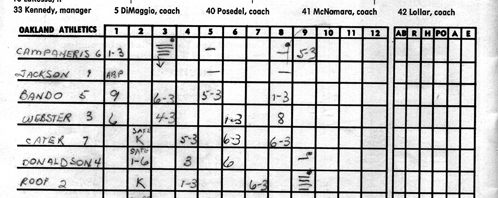
Typical 1960s-stadium scorecard chronicles all the action
As 2013 comes to a finish and activity at ROTB HQ reaches a fevered pitch (poor pun intended), I (Evander) would like “to close” (not Mariano-style) the year with Random Notes on fine, even great, baseball players who are by and large, if not exclusively, not or never to be enshrined in Cooperstown, or are often less remembered…but would make anyone’s All-Star squad at various points in their respective careers: an eclectic if not oddball grouping.
Smoky Joe Wood won 34 games in 1912, losing only 5. He seemed on his way to immortality when his career was cut short at a total of 117 wins.
Spud Chandler sports the highest winning percentage (.717) of any hurler with 100 or more victories. He began late in life, had arm woes all along, and pitched his best seasons during World War II, when the biggest stars were in the armed forces.
Mort Cooper won the N.L.MVP in 1942, compiling a record of 22-7. His lifetime ERA is a microscopic 2.97. But his career was a half-season short of ten, the Cooperstown minimum. Like Chandler, Mort carved out his best during World War II; and perhaps for this reason alone, he never would be elected to the shrine in his namesake village.
Herb Score was almost undoubtedly the greatest southpaw-pitching prospect ever till his career was stymied by a line drive thro the box and to his eye, off the bat of guilt-ridden Gil McDougald. Also headed for a career as far as the eye could see, Tony Conigliaro was similarly struck, in the left eye, by a pitched ball from Jack Hamilton. Score and Conigliaro remain two at the exclusive circle center of “what-ifs” in Major League Baseball.
Bobby Shantz won the A.L. MVP in 1952 and had other good seasons. He may have been the most vertically challenged major-league great and later with the Yankees might have won the seventh game of the 1960 World Series, both with his pitching and his surprising bat.
Dean Chance lit it up the A.L., pitching-wise, in 1964: ERA 1.65, better than Sandy Koufax (who truly made the most of his potential—still the youngest man inducted into the Hall of Fame) in the other league. Dean was twenty-three-years old but did not grab his “chance” at clear immortality in any other year or collective years.
Vida Blue was a left-handed phenom. I tend to place him in a category with Chance (above) and, particularly, Gooden (below). The potential to be one of the top-five lefties ever was before him.
Dwight (“Doc”) Gooden was the most phenomenal teenaged pitcher since Bob Feller (who won 81 games by aetat. 21). At 19, Gooden swept to a record of 17-9 and struck out 276 batters. He was even better at 20: 24 wins, 4 losses, with a miserly 1.53 ERA. Drug-use drastically curtailed his career from there.
In 1938, Johnny Vander Meer pitched consecutive no-hit games and went three innings in the third before giving up a hit. Thus he is remembered. Truth is he altogether only won 119 games, losing 121.
Hotheaded Johnny Allen went 15-1 (that’s winning 94 percent of the time), with a 2.55 ERA, for the 1937 Cleveland Indians. I believe he lost the last game of that season 1-0. No wonder he was steamed. Altogether, his career winning percentage is .654 and features 142 victories.
Arky Vaughan, who was inducted into the Hall of Fame by the Veterans Committee, is perhaps the second-greatest non-contemporary (1980s ff.) shortstop after Honus Wagner. But quick! How many non-experts know who Arky Vaughan is?
Joe Sewell, likewise honored by the Veterans Committee, struck out 3 times in 1932, and 114 times in 7,132-career at-bats. This is every 62.5 he came to the plate and did not walk. We will never see his like again.
Travis Jackson is yet another Veterans Committee inductee. He may be the worst World Series performer in the Hall of Fame, giving Dave Winfield stiff competition in this dubious department. In 1924, over seven games and twenty-seven at-bats, Jackson hit .074. In an earlier Series, his average was nil: OK, he only came to bat one time.
At twenty, Al Kaline, who was elected to the Hall of Fame on a regular vote, batted .340 with 200 hits on the nose for the Tigers. He never came close to this average again, though he memorably concluded his career with 399 home runs.
Dick Wakefield was the first so-called Bonus Baby, signing for the astonishing sum of $52 thousand (and a car—after all, this was another Detroit player) in 1941. He even batted .355 in half a season. But maybe things came too easily for Wakefield, as he soon enough faded from the major leagues.
Luke Appling, in the Hall of Fame and, like Vaughan, Sewell, and Jackson via the Veterans Committee, played 142 games at shortstop in 1949. What makes this a remarkable feat is his age at the time: forty two. Derek Jeter, I’m sure, has taken note.
Robinson Cano could not leave $70 million on the table. That is roughly the difference between what the storied New York Yankees offered their star second baseman and what the Seattle Mariners are paying. The Mariners have set Cano for life with a 10-year, $240 million (or so) contract.
Who could blame Cano?
Only the fans get caught up in this Tradition stuff. Cano, who was named for Jackie Robinson, “Will never be at a Yankees Oldtimer’s Game.” Such is fanspeak, the blather of call-in shows on sports-talk radio. It is meaningless to players.
When newly acquired backstop Brian McCann met the New York media and was asked about Yankees Tradition and his uniform number (34), instead of invoking Yankee Tradition (“Three is for the Babe, four for Gehrig.”), McCann honestly blurted out something about the number having personal meaning from his days in Little League.
Johnny Damon is the first “Modern Mercenary.” He played for seven clubs in eighteen years. He made a pile of money. He gave his all everywhere he went. But he would never be a Royal For Life or a Red Sock For Life. Ditto Carlos Beltran, with this sixth team going into his seventeenth season. Jacoby Ellsbury has been with two franchises approaching his eighth year. Unless God forbid something not good happens, don’t expect Ellsbury to end up with his current club, the Yankees.
The New Breed of Modern Mercenary is a businessperson. He plays hard. He plays smart. He is not selfish in looking out for his business interests. He can be a team player while building personal stats. Philosophers dub this “enlightened self-interest.” The big-market team is preferred. But Seattle will do.
The next stop for Major League Baseball, as it slowly internationalizes (as is inevitable), is the development of an IPL equivalent, wherein the money speaks most loudly and does nothing to muffle fan interest.
When the South African–born batsman Jonathan Trott joined the England cricket team in 2009, commentators noted how in taking his guard at the start of his inning Trott went through a routine of scratching at the pitch that could only infuriate the opposition. Yet Trott seemed unperturbed by the snide comments directed at him by the fielding aside as he amassed a world-class record in Test and one-day cricket, and soon enough became an immoveable and reliable number three in a very formidable top order.
Cricketers, like baseball players, are a superstitious bunch. Once they achieve success—or, perhaps, hoping to achieve that success—they follow a certain pattern: buttoning and unbuttoning their gloves, swinging the bat a particular number of times, running up to bowl or unwinding the pitch in a regular (if perhaps eccentric) way. It turns out, in Trott’s case, that the tics and quirks of his routine were a way not only of shutting out the negative comments of the opposition, but to still his own negative thoughts. But this system has now broken down, and he’s become the third England player—after Marcus Trescothick and Michael Yardy—to return home from touring because of a “stress-related illness.”
To its credit, cricket is reacting maturely to the revelation that one of the top players in the world has a depressive illness. Thankfully, the kind of macho, “can’t-hack-it-English-wimp” talk has been absent. It’s difficult to know whether there’s something systemic here, as opposed to the frailties of one individual, but it can’t help cricketers who may be prone to depression that they play so much cricket that they’re on the road virtually the entire time. It’s a lonely and highly pressurized existence—in spite of all the money and the battalion of therapists (physical and otherwise) that attend the big sides.
Trott’s departure leaves England in a hole. They lost the first Test in the series against Australia (not an unusual feat for this side, which mysteriously always seems to start slowly), and the momentum is all with the home team. Both sides have stated that the constant barracking being offered by one team at the other throughout the game has not undermined either side; but it’s hard not to come to the conclusion that England simply freaked out. Everything depends on the first day of the forthcoming game in Adelaide. If they’re not to be steamrolled by Australia, England will need to come out very strong: mentally, physically, and even verbally. And they will need to play out of their skins.
The Ashes is upon us again. “Wait,” we hear you cry. “Didn’t Australia and England just play a tournament this summer, and isn’t this contest meant to occur in the respective countries once every two years?” The answer is “yes” to both questions. This time, however, the wise gentlefolk who schedule cricket competitions have decided that in order to provide nations with time to prepare for cricket’s World Cup (in 2015), the Test matches and one-day games that Australia will play against England in Australia should occur from November 2013 to February 2014 and not a year later. The result is that cricket’s marquee competition has not been more squeezed since the earl of Sandwich had an idea what to do with his extra slices of bread.
England managed to beat Australia 3–0 this summer in England, in spite of the fact that the hosts played below par. In fact, so indifferently did the team play that it would be more accurate to say that Australia threw it away: the Baggy Greens (as the Aussies are known after the shape and color of the caps they wear) lost crucial moments in each match and failed to take advantage of those when England were on the rack.
Coming into the series, Australia are on the upswing and England—in spite of being placed two above their competitors in the Test world rankings—look vulnerable. A lot depends on how fit each side’s bowling department is, and whether Stuart Broad or Mitchell Johnson for England and Australia respectively can be their destructive best. Whatever the situation, it’s not likely to be pretty. The wise money is holding bets until the first few days of the first Test (which begins on Thursday) have played themselves out.
Sachin Tendulkar leaves the field for the last time.
Regular Right Off the Bat readers (we few, we happy few) will have noticed that the cricket half of this blog has fallen silent for the last few weeks. Life has taken your cricket correspondent away from the blog for a while, even though the game of cricket has continued to be played around the world. Perhaps the biggest story in cricket at the moment is the ultimate retirement of Sachin Tendulkar, the colossus of Indian cricket. Some of us had wished this day had come two years ago, when the Little Master scored his hundredth international hundred, and was still at the top of his form. But cricket—like baseball—finds it hard to let go of past glories and faded superstars and, as in baseball, its players and fans are obsessed with statistics. So, Sachin stopped playing the one-day game and concentrated on Test matches, hauling his tired 40-year-old bones into his 199th and then 200th Test match in a meaningless series with the West Indies. Both matches, in which the much-depleted West Indies were soundly thrashed, were staged in Mumbai, to allow the Little Master to say goodbye to his home crowd. As it turned out, Sachin only had to bat once in either game. In his final innings, he meticulously constructed a beautiful 74 that recalled past glories and let him go out on a high. After the match was over, he gave a typically understated, generous, and modest speech.
Like baseball fans, cricket lovers enjoy measuring players and their times against previous geniuses who stepped onto the fields of green. And it’s always risky, in the immediate glow of a player’s retirement, to attempt to assess accurately whether the individual belongs in the Pantheon. It’s fair to say, however, that no one will ever overhaul Sachin’s number of international centuries, or accumulate more runs in international cricket, or play as many Test matches. Because Sachin was playing cricket at the highest level at only sixteen, it’s also very unlikely that anyone following him will play the international game for as long: the demands on one’s fitness and one’s body are now that much greater than when the boy first strode out to bat against Pakistan in 1989.
Sachin Tendulkar faced some of the best bowlers of the age and retired with an average in the low 50s—which immediately places him in the “great” category, and 20th among those batsmen who no longer play. His one-day average (44.83) is also among the best that form of the game has notated (he’s 19th in the list of all batsmen). But these stats don’t reflect his importance as a player, or more particularly as an Indian player. More than one commentator has noted that Tendulkar rose to prominence as the face of a resurgent and newly confident India. His team-spiritedness, his technical correctness combined with a capacity to improvise no matter what form of the game he was playing, and his everyman persona allowed him to become the vessel into which Indians poured their aspirations, their passion, and their confidence, and then (to change the metaphor) to make the Little Master the vehicle in which they could drive their nation forward. In a time of bling, brashness, and bravado in Indian cricket, Tendulkar represented discipline, respect for the game, and continuity. Yet he was also supremely confident and dominant at the crease—the person whom one billion people worshipped whatever their caste, region, religion as an exemplar of India at its most excellent.
Cricket, like baseball, has to deal with corruption and prima donnas on the field, and incompetent and blinkered administrators off it. Cricket fans, like those in baseball, tend to gravitate to the flamboyant or outlandish players—flawed geniuses whose moments of extraordinary brilliance in crucial plays don’t disguise but only make more vivid their periods of ordinariness. We remember these players for what they might have been had their egos, their love of the limelight, or their injuries not blighted their careers. In short, they are always interesting because we can see something of our own self-destructiveness in them. Conversely, players like Yankees closer Mariano Rivera and Sachin Tendulkar—who’ve accumulated unimaginable statistics over a long period of time; whose characters are unimpeachable and whose understated yet absolute professionalism and dedication to the team are without question—feel removed from us: too perfect to be approachable. Even their modesty makes them somehow beyond our ken; their discipline even renders them (mirabile dictu) slightly boring. The very focus and ruthlessness they bring to the game remove the emotional sloppiness and/or personal edginess that create those fascinating characters that you want to talk and think about after the game.
It’s therefore hard to say how much effect Tendulkar will have on the game itself—or even India. The team has its new set of stars—temperamental, glamorous, flamboyant. With its economy stalled and its cricketing culture questioned, India is no longer as confident in itself as it was a few years ago. Tendulkar, his reputation unsullied by scandal, profligacy, or flameouts, will now have to decide what he wants to do with the rest of his life. One hopes that he will look beyond cricket; but, given that’s all he’s ever known, he could do worse than sort out the administration of the game in the country that loves him so much and to which he has already given more than enough.
Turner Field is what’s left of the 1996 Summer Olympics Stadium, modified for baseball. Its shelf life of barely twenty years is eyebrows’ raising to say the least.
“The Ted,” which is said to have the best food court in Major League Baseball, holds roughly 50,000 munchers. The new field will have a capacity of 42,000.
Why would a club abandon its downtown home—for a smaller one no less—after only twenty seasons? Do I (Evander) need to ask?
Money!
Residents of Cobb County, Georgia, will fund $300 million, or 45 percent, of a new $672 million stadium for the Braves, county officials said. The team would kick in $372 million.
The Cobb County Commission says that financing would not rely on increased property-tax revenue. The majority of the contribution will be covered by a portion of a $368 million revenue-bond sale by the Cobb-Marietta Coliseum & Exhibit Hall Authority, which will own the stadium.
The Braves are thus in debt for $92 million over the length of a thirty-year lease. (Let’s put this total into focus: It is about one-third of Alex Rodriguez’s polished contract with the Yankees.) The remainder will be raised thro existing property-tax revenue, taxes and fees on hotels and businesses, and a rental-car levy that has yet to be approved.
“By taking on more than 90 percent of the upfront costs of the stadium, we are minimizing the amount that has to be bonded by Cobb County,” says Mike Plant, the team’s vice president of business operations.
Due to the Braves extraordinary N.L. success, not to mention their famous owner (this field is one of a handful not to carry a corporate name) as well as the Summer Olympics for which it was constructed, Olympic Games generally deemed one of the more financially responsible, Turner Field has perhaps been seen both on TV and live in its short existence by more people than any other ballpark.




 Right Off the Bat